Modern Antique Chairs

By Frank Parker

It is becoming more common to re-upholster antique furniture using bright modern fabrics. At first this may seem sacrilege to connoisseurs of fine furniture but if quality antique furniture is being saved no one can complain.    

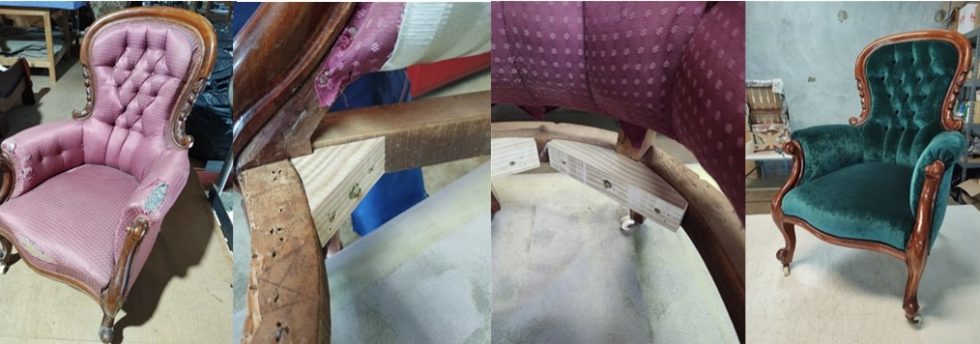
A client approached us saying she had found a pair of identical ‘Grandfather’ antique chairs beside the railway line in York W.A. At first we just assumed these were nothing but discarded antique reproduction chairs however upon inspection our client was correct, they were indeed genuine antique chairs from the mid to late 19th century.

We completely removed the existing upholstery and carried out some structural repairs then touched up the polish work. We then used traditional methods to re-upholster these chairs only compromising by using premium foam seat and inside arm/back overlays. A modern teal velvet with black velvet piping was used to cover the chairs and trimmed with black gimp.

Well what could we say, the clients were elated and the chairs looked stunning! The chairs were saved and our clients can enjoy their rejuvenated furniture for many years.
Similar Posts

  • Why do modern sprung cushions have problems?

    cushion upholstery Perth

    What are contemporary sprung cushions?

    Contemporary sprung cushions have been marketed over the last decade as a superior concept however there are major issues regarding the effectiveness of using ‘spring pockets’ in the fabrication of seat cushion inserts.

    How are traditional spring cushions different to modern spring cushions?

    Traditional sprung cushions were constructed using mid-gauge coil springs and hand sewn into a hessian case then encased with flock and fitted into a box piped seat cushion with sewing usually finished by hand stitching. Seat cushions constructed this way tend to stand the test of time as is evident by cushions still used in antique furniture.

    However the fabrication of modern sprung cushion inserts utilise light-gauge coil springs encased in a series of thin polyester pockets which are normally referred to as ‘spring pockets’. These spring pockets are placed in the centre of the cushion inserts and sandwiched with polyurethane foam then usually encased with polyester fibre. With moderate to heavy use the spring pockets tend to distort with the springs often fracturing the casings. The result is a distorted and uncomfortable seat cushion and maybe a costly repair bill outside the warranty period.

    What about the option of premium quality foam cushions?

    The sales personnel promoting the “advantages” of sprung cushions usually infer by definition that the base is also sprung but most sprung cushions are on bases fitted with elastic webbing. The truth is that there is nothing wrong with a settee base correctly fitted with high quality elastic webbing. However a superior cushion insert can be effectively achieved by simply using premium quality polyurethane foam encased in polyester fibre and no spring pockets!

    Call Us To Help You With the Cushions on Your Furniture
  • Co-ordinating classic chairs

    Timberline Furniture commenced operations in Perth WA with the factory being located in Willetton. The furniture manufacturing business was founded by Ron Jones and Hedley Van Der Straaten in the early 70’s and ran through to the mid 90’s with about 10 – 12 staff. Ron was a Wood-Turner by trade and managed operations with Hedley managing sales and general business. Timberline predominantly manufactured dining furniture but also made some lounge and occasional furniture. During the 80’s they entered into a collaborative venture with co-ordinated designs, Trustyle Furniture making the lounge suites, George’s Cabinets making the cabinetry and Timberline the dining suites. These co-ordinated furniture ranges were sold by furniture retailers throughout W.A.     

    Our clients were involved in furniture retailing and furniture transport for many decades and contacted us to re-upholster their Timberline ‘Captain’s Chairs’. These were a very popular occasional chair from the late 70’s and early 80’s not just in residential sales but they were also used in commercial hospitality applications.

    The chairs were originally upholstered in a Nylex Deerhide’ vinyl which was a quality product in its days so we advised using a vinyl from the Austex ‘Studio’ as a quality replacement. The existing upholstery was completely removed, then the show-wood frames cleaned and polished. New high density foam was laminated onto the padded areas and the chairs were upholstered to the original finish with piped and space studded detail.

    Our clients re-upholstered ‘Captain’s Chairs’ looked in place around their bar with complimentary comments passed over a few drinks.

    Call us Today
  • Re-upholster Charles Mackintosh chair

    A client approached us saying they had a ‘Mackintosh’ chair in desperate need of re-upholstery. They had purchased this lounge chair in the UK in the 1970’s and it had just been re-upholstered, they were told it was made about 1910 and was a Charles Rennie Mackintosh (1868 – 1928) design reflecting the ‘Arts and Craft’ period.

    Charles Rennie Mackintosh was a Scottish architect and designer who played an important role in the turn of the century ‘Arts and Craft’ movement. He became interested in architecture at a young age and enrolled into the Glasgow School of Art at fifteen meeting the McNair children (marring one of the sisters). The foursome collaborated becoming renowned for their refined stylization of furniture. In 1889 Mackintosh became an apprentice at the architectural firm Honeyman Kreppie and was made a partner in 1901. He demonstrated a break from traditional Victorian design being influenced by Japanese and Celtic art. He was famously commissioned by Catherine Cranston to design the Willow Tearooms (Glasgow) interiors and furniture for which he developed the famous Argyle chair.

    We completely stripped the upholstery to the frame on this chair and judging from the construction techniques it coincides with the period. The chair was then re-sprung and completely re-upholstered being covered in a linen supplied by our clients.

    There is however something extremely strange regarding this chair? The construction techniques coincide with the with the ‘Arts and Craft’ period and the design coincides with the Mackintosh style of the period however from our research he never designed a fully upholstered lounge chair, only dining and occasional chairs with a few show-wood framed lounge chairs. Our client loved their rejuvenated chair and the mystery remains!

    Call us Today
  • Mechanical rocker/glider chair – reupholster

    Mechanical rocker/glider chairs or platform rocker chairs are a type of rocking chair which moves as a swing seat, where the entire frame of the seat is attached to the base by means of a double rocker four bar linkage. The non-parallel suspension arms of the linkage cause the chair to simulate the motion of a rocking chair. The mechanical rocker/glider chairs were first manufactured in the United States and Canada during the 1930’s.

    Our client in her late 80’s approached us to rejuvenate her rocker glider chair and we just loved her story. As a young child in the pre-war years she travelled from her home in Rugby England with her father by train to Edinburgh Scotland to visit her grandmother. Apparently her grandmother had very strict house rules however when she had the chance she would love to rock in her grandmother’s chair. A few years later after the passing of her grandmother her aunty asked if she would like any of her grandmother’s possessions with the obvious response, “the rocking chair”. Then some eighty years later we were given the task of reupholstering her special chair.

    Our client had selected an olive cut pile cotton velvet for the upholstery which suited the chair and reflected the era. All the upholstery was removed from the chair then the timber frame was cleaned and polished. Jute webbing was fitted over the seat and then a hessian overlay and premium padding with a polyester overlay. After the outside back was fitted the same process as the seat occurred then the arms pads were built up with premium padding and polyester overlays. The inside back, seat and arm pads were then upholstered and unlike the original chair which was trimmed with gimp we used self-covered banding which was then space studded.

    When the chair was delivered our client had tears of joy saying this was something she had wanted to do all her life.

    Call us Today
  • Custom Upholstery

    This custom-made dining lounge was designed and manufactured by a cabinet making firm then upholstered by a local upholstery business. The frame was well designed and constructed however there were continual substantial issues with the upholstery. Unfortunately this is something that occurs to often in our industry. 

    A client approached us saying she had a custom-made dining lounge and there were substantial issues with the upholstery and she had given up trying to negotiate any solution with this upholstery business. The entire front edge of the seat had collapsed and buttons which she did not want but were initiated by the upholstery firm had ‘popped’. Our client engaged us to completely re-upholster this dining lounge.

    We completely removed the existing upholstery and discovered the problems causing the clients concerns. The previous upholsterers had used high quality foam on the seat however they had used a water based contact adhesive to which there are still major application problems and is was simply just not effective. Also the reason they had to place buttons into the seat and back panels was that the patterns were not true to the frame sizes causing the cushions to distort.

    We started from scratch making templates true to the frame then fabricated premium cushioning and laminated it with bonded polyester fibre. The cushion covers were then carefully marked with sewing indicators and sewn to shape as such large panels can either be stretched or gathered. The lounge was then upholstered with minimal effort as the fabric covers fitted perfectly.

    The result was that our client was absolutely overwhelmed with the result and we have since received repeat work from her. This just goes to show that quality work is always the best form of advertising and everyone is a winner.

    Call us Today
  • Leather Furniture Repair

    leather furniture repair perth

    This leather is an exceptionally high quality semi-aniline leather used to upholster a beautiful contemporary settee. The client thought that the scarring was excessive and considered them as leather imperfections. With this type of rustic look natural leather defects are acceptable and indeed considered a feature. However scarring where the surface is broken can be seen as a type of leather damage and should be confined to inconspicuous areas of the upholstery.

    This was a case in which the client complained with possible good reason. The manufacture should have been more prudent with the leather cutting process and the furniture retailer should have better explained the natural features of rustic semi-aniline leather to the client. Fortunately this settee was made in Australia and both the manufacturer and retailer acted quickly  to rectify the problem resulting in a happy ending!

    Call us Today to Have Your Timeless Furniture Restored