Re-upholster Charles Mackintosh chair

By Frank Parker

A client approached us saying they had a ‘Mackintosh’ chair in desperate need of re-upholstery. They had purchased this lounge chair in the UK in the 1970’s and it had just been re-upholstered, they were told it was made about 1910 and was a Charles Rennie Mackintosh (1868 – 1928) design reflecting the ‘Arts and Craft’ period.

Charles Rennie Mackintosh was a Scottish architect and designer who played an important role in the turn of the century ‘Arts and Craft’ movement. He became interested in architecture at a young age and enrolled into the Glasgow School of Art at fifteen meeting the McNair children (marring one of the sisters). The foursome collaborated becoming renowned for their refined stylization of furniture. In 1889 Mackintosh became an apprentice at the architectural firm Honeyman Kreppie and was made a partner in 1901. He demonstrated a break from traditional Victorian design being influenced by Japanese and Celtic art. He was famously commissioned by Catherine Cranston to design the Willow Tearooms (Glasgow) interiors and furniture for which he developed the famous Argyle chair.

We completely stripped the upholstery to the frame on this chair and judging from the construction techniques it coincides with the period. The chair was then re-sprung and completely re-upholstered being covered in a linen supplied by our clients.

There is however something extremely strange regarding this chair? The construction techniques coincide with the with the ‘Arts and Craft’ period and the design coincides with the Mackintosh style of the period however from our research he never designed a fully upholstered lounge chair, only dining and occasional chairs with a few show-wood framed lounge chairs. Our client loved their rejuvenated chair and the mystery remains!
Similar Posts

  • Boans Furniture – reupholster

    The Boan brothers opened their first department store at Wellington Street Perth in 1895 then moved into selling furniture in 1912. After the First World War demand for furniture was strong so Boans commenced manufacturing furniture from a factory located corner Saunders and Glide Streets Perth. The range of furniture made was extensive from cabinetry to upholstered furniture, mattresses and cane furniture.

    With the anti -Asian sentiment dominate during this period the Factories Act of 1904 forced Asian furniture manufacturing companies to stamp on their products “Asiatic Labour” and so Boans like many other local furniture manufacturers of time took advantage of this situation advertising that their furniture was made with “European Labour Only”.

    During the late 1960’s Boans started retailing furniture from other specialist manufactures and also started importing furniture. Boans remained dominate and indeed an iconic retailing business in WA for almost a century and was sold to Myer in 1986.

    We were approached by a mother and daughter who had fond memories of their lounge furniture purchased from Boans in the early 1960’s which was made under licence to Parker Knoll in the UK. The lounge suite had served the family well for almost 60 years however it was certainly due for re-upholstery.

    They selected a Warwick linen to replace the original Sanderson linen so the furniture would retain an elegant appearance in their sitting room. We completely removed all existing upholstery then rectified a few minor structural issues with the timber frames. The tension springs were replaced and the bodywork padding was replaced with high density polyurethane foam and the cushions were fabricated from premium foam and encased with bonded polyester. The linen was pattern matched, cut and sewn then upholstered to its original splendour.

    Call us Today
  • Tub Chair Reupholstery

    tub chairs perth

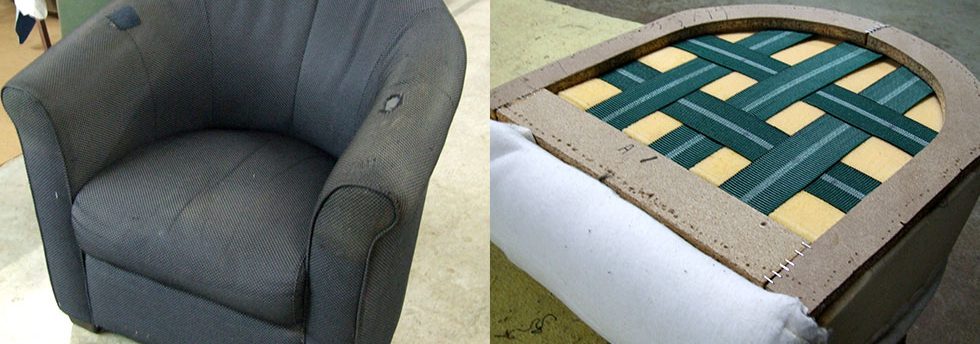
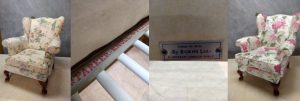
    These tub chairs were purchased three years ago from a leading WA furniture retailer. The clients paid a high price for these chairs which were sold to them as superior quality Italian made pieces of furniture. The manufacturing labels fixed under the chairs reveal they were made in China.

    The covering which is a very poor quality laminated fabric has delaminated in areas of wear. The frames can only be described as having been ‘slapped together’ by unskilled labour. The poor quality elastic seat webbing was breaking down and the low density foam collapsing.

    As part of the tub chair reupholstery process, a new seat frame was constructed from a single piece of structural grade plywood, laced with heavy duty elastic seat webbing then laminated with high density premium grade cushioning. The furniture recovering of these chairs was finished with a quality Australian made fabric.

    The end result was that the client spent about 70% of the initial purchase price to have their tub chair upholstery problems rectified. This makes a mockery of the old saying “the high purchase price is long forgotten but the bitterness of poor quality remains” as these clients were stung with a high purchase price and left with the bitter taste of poor quality. I guess the moral of the story is “buyer beware” so do your research prior to purchase and maybe look a bit closer to home!

    Call us Today
  • 1960’s American Sofa-Bed

    Sofa Bed Reupholstery Perth

    1960’s American Sofa Bed Restoration

    It started with a home consultation for our client

    This is the sofa-bed’s history

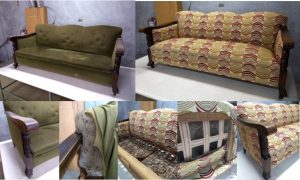
    Upon inspection of this sofa-bed it became apparent that it was made in the U.S in 1968. The frame was constructed from solid American Oak. The sofa-bed action was manufactured by Windsor of Canada who are renowned for their high quality mechanical componentry which tended to be over engineered and will subsequently last the decades. The result was with such a robust frame and action the sofa-bed was to be re-upholstered.

    The restoration process

     We removed the sofa-bed action and stripped the existing upholstery to the frame. The upholstery fabric selected by our client was similar to the original cover so it was guaranteed suitable. The cushion inserts were down and feather so we encased these in a bonded polyester fibre and replaced all the body padding with high density foam. We basically used the same upholstery techniques but tidied up the finish including doing the skirt in three sections to match the back cushions.

    Happy clients of Parker Interiors

    The final result is fine and yet functional sofa-bed superbly rejuvenated for our clients to enjoy for many years into the future.

    Call us Today for Sofa-Bed Reupholstery

  • Reupholstery of Late 19th to Mid 20th Century Classic Australian Furniture

    mid century chair upholstery

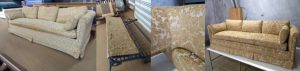
    This classic mid century three seater couch was manufactured in 1948 by Hicks Furniture in Kalgoorlie Western Australia. Some classic furniture was made in major WA regional centres from the late-19th century through to the mid-20th century. This was due to the problems associated with long distance transport of bulky fragile items and the fact that many skilled trades people from all walks of life migrated to these areas during the preceding gold rushes. However the other important factor is that the demand existed during this time frame for quality upholstered furniture.

    This midcentury couch was purchased by its current owner who is now 93 years of age when he was married at the age of 24, as a present for his wife. It is interesting to note that it was re-upholstered in the 1970’s. The original sprung edge was replaced with timber rails. The initial upholstery fabric was a tapestry and it was re-upholstered in an olive velvet. Unfortunately the furniture repair of this piece wasn’t detailed. It was limited to only replacing a sprung edge with timber and placing the new fabric over the old sandwiched with a layer of foam.

    We stripped the existing upholstery back to the frame then carefully knocked the joints apart, glued then clamped and screwed the frame where necessary. Our client wanted to retain the history of this mid century sofa so we simply cleaned up the show-wood timber. We also touched up the chips with an oak stain and then used a quality furniture polish to bring back the shine. The frame was then webbed and re-sprung mainly using traditional upholstery methods with an art-deco upholstery fabric. The result is that a classic Australian made couch has been given a new lease of life for future generations to enjoy.

    Call us Today to Have Your Mid Century Furniture Beautifully Restored
  • Le Cornu Furniture – reupholster

    Le Cornu was an iconic South Australian furniture manufacturing and retailing business. Operations commenced in 1861 when Phillip Le Cornu started a wholesale cabinet making business in Adelaide. In 1885 the factory was largely destroyed by fire and recommenced operations at a former church in North Adelaide. In 1921 the founder died and his son Phillip took over the business expanding operations and by 1924 employed 25 people.

    In 1954 the business went factory direct with a diversified range of furniture and over the next two decades expanded retail stores in S.A and Darwin. In 1989 the North Adelaide store was closed and then the business was sold to Fantastic Holdings in 2008.

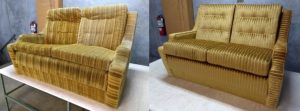
    Our client approached us wanting to re-upholster a settee purchased by his parents from Le Cornu in 1959. This settee was the surviving piece of the lounge suite which he grew up with and lounged upon as a teenager. It was still upholstered in the original fabric being a ribbed velvet which would have been the latest trend at the time of purchase.

    We removed all the existing upholstery from the settee frame and it was well constructed with little structural work required. The frame was re-sprung with heavier gauge no-sag springs on the seat and the back springs were replaced with the same gauge. The springs were linked, outside arms and back were lined with hessian and high density body work padding applied. The original cushion inserts were latex and these were replaced with polyester encased premium cushions. The two seater settee was then upholstered to its original finish in a ribbed Zepel gold velvet.

    Our client was gobsmacked upon delivery of the settee saying it was just as he remembered it as a child growing up in Adelaide.

    Call us Today
  • Re-styled 1940’s chairs

    Occasionally clients are unhappy with the style of the chairs presented to us for repair and re-upholstery. This can be as a result of either initial design flaws, poor re-upholstery or poor reconstruction as a result of previous damage or sometimes a combination of these factors. The idea is not necessarily to bring a chair back its purest original form but occasionally compromise with slight re-styling to compliment the client’s décor.

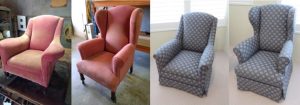
    These two 1940’s chairs were presented to us by a client as they had been passed down to her through the family. She wanted the chairs to be re-upholstered however she wanted the arms modified on one chair and the wings to be altered on the other chair. This re-styling was required partially due to initial design flaws but also due to past re-upholstery exaggerating these flaws.

    We completely stripped the existing upholstery on both chairs down to the bare frames. The top arms on one chair were then cut down to a cigar shaped arm in keeping with the design while the other chair had a plywood strip removed from the inside wings which improvised as a thumb roll. The two modified chair frames were then re-upholstered using a combination of traditional and contemporary methods.

    When these re-styled chairs were delivered to our client she was ecstatic with the outcome. We trust the chairs will be enjoyed and continued to be passed down to future generations.

    Call us Today