Uncategorized

  • Mechanical rocker/glider chair – reupholster

    Mechanical rocker/glider chairs or platform rocker chairs are a type of rocking chair which moves as a swing seat, where the entire frame of the seat is attached to the base by means of a double rocker four bar linkage. The non-parallel suspension arms of the linkage cause the chair to simulate the motion of a rocking chair. The mechanical rocker/glider chairs were first manufactured in the United States and Canada during the 1930’s.

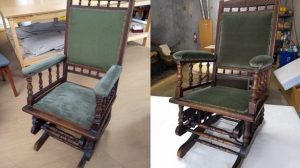
    Our client in her late 80’s approached us to rejuvenate her rocker glider chair and we just loved her story. As a young child in the pre-war years she travelled from her home in Rugby England with her father by train to Edinburgh Scotland to visit her grandmother. Apparently her grandmother had very strict house rules however when she had the chance she would love to rock in her grandmother’s chair. A few years later after the passing of her grandmother her aunty asked if she would like any of her grandmother’s possessions with the obvious response, “the rocking chair”. Then some eighty years later we were given the task of reupholstering her special chair.

    Our client had selected an olive cut pile cotton velvet for the upholstery which suited the chair and reflected the era. All the upholstery was removed from the chair then the timber frame was cleaned and polished. Jute webbing was fitted over the seat and then a hessian overlay and premium padding with a polyester overlay. After the outside back was fitted the same process as the seat occurred then the arms pads were built up with premium padding and polyester overlays. The inside back, seat and arm pads were then upholstered and unlike the original chair which was trimmed with gimp we used self-covered banding which was then space studded.

    When the chair was delivered our client had tears of joy saying this was something she had wanted to do all her life.
  • Restoration of Antique Chairs

    Genuine fine antique chairs become scarcer as time ticks on due to fatigue with function and unnecessary destruction. Poor and inappropriate furniture repairs due to operators not possessing the necessary skills also increase the scarcity. It is important to always use a reputable and skilled restorer.

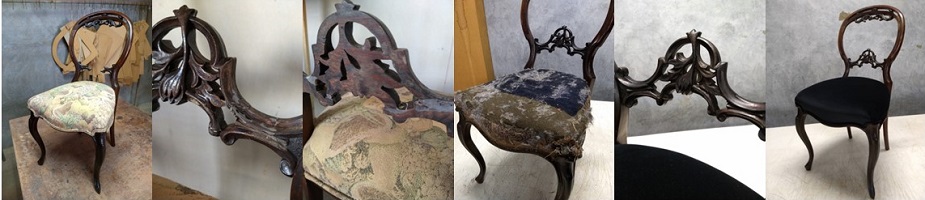
    Our client approached us with a dining chair from the 1880’s which was bequeathed to her by her maternal grandmother as one was for each granddaughter. After receiving the chair she had it repaired and re-upholstered however within a short time with only gentle use the lower back carved section again broke away. The chair remained in her lounge room as a decorative piece for several decades but constantly annoyed her until we were presented with the repair and re-upholstery task.

    The lumbar carved section had broken away for two reasons; only an average quality PVA glue had been used for the repair and where the timber had fractured there was burl grain so it was originally flawed. We chipped away the remaining burl timber then stage by stage rebuilt the carved section in question using two-pack epoxy resin. Each section was masked-up and filled with resin then sanded into shape. After this was completed the re-built section was stained to match the remaining timber work.

    The existing upholstery was then completely removed with new jute webbing being fitted, coil springs then laced in and tied down and a hessian overlay fitted. A synthetic thumb roll was then fitted to the seat edges and filled in with high density premium padding then a bonded polyester overlay. The chair was then upholstered in a black cut pile cotton velvet and finished with twin piping. This method reduces the cost for our client but also creates a usable and durable seat however not authentic of the period.

    Our client was elated with the finished result especially because the chair would once again become a functional piece of furniture.

    Call us Today
  • Re-upholster Antique Chairs

    Occasionally we receive antique chairs which are basically well preserved but they have been previously shabbily re-upholstered or upholstered out of context with the era. This rarely does the furniture justice and usually results in complete restoration.

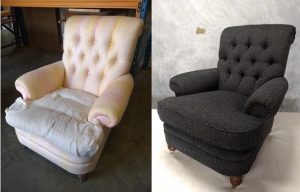
    Our client came to us with a lounge chair made in the 1890’s having been originally purchased by her deceased husband’s grandparents. She was honest in explaining that under her instructions the chair had been re-upholstered in the early 1980’s in a pastel cotton and the style modernised to match their décor at a previous residence. She was now ashamed of her previous decision and wanted the chair re-upholstered to its previous glory.

    The chair’s design had been modernised by having a loose seat cushion fitted and absence of piped detail. We removed all the upholstery stripping the chair down to the bare frame and the turned timber legs were then cleaned and polished. Heavy weight jute webbing was then fitted to the seat and back, the coil springs laced, tied down then hessian overlays fitted. We used synthetic ‘thumb roll’ on the seat front, arms and back scrolls then laminated premium polyurethane foams finished with polyester overlays. The seat cushion inner was fabricated from high resilience foam and encased with bonded polyester fibre.

    The chair was then upholstered using a fabric selected by our client which suited the chair and was basically in keeping with the period. The result was a chair which was modernised to a degree under the cover for comfort however retained much authenticity with the upholstery finish and piped detail. Our client was over joyed with her chair and no doubt will become a family heirloom.

    Call us Today