Re-furbish Library chairs

By Frank Parker

Upholstered library chairs

The History of These Upholstered Library Chairs (William IV Chairs)

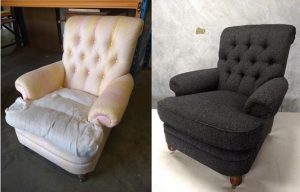
A set of two leather look library chairs were presented to us by a gentleman who wanted them rejuvenated. These chairs were purchased new in the 1920’s by his grandfather in England. “Library” chairs also referred to as “William IV” chairs were initially constructed in the 1830’s thus this design of chair had already been in circulation for almost a century.  

Library Chair Details

These chairs were constructed from English Oak and traditionally upholstered in a tapestry fabric. They had then been re-upholstered in the 1970’s using a Nylex vinyl named “Deerhide”. Deerhide was a product of its day and although extremely popular, perhaps these chairs deserved to be covered in something slightly more elegant.

How We Beautifully Restored These William IV Chairs

We stripped these well worn chairs completely back then cleaned and polished the elegant carved timber frames. We used the original upholstery methods. This included jute webbing, coil springs and stitched edges and indulged in a final thin layer of premium foam. The upholstery was also finished to the original standard with space studded self-covered banding.

This resulted in this pair of two library chairs being brought back to their former glory and a very happy owner.
Similar Posts

  • Custom Upholstery

    This custom-made dining lounge was designed and manufactured by a cabinet making firm then upholstered by a local upholstery business. The frame was well designed and constructed however there were continual substantial issues with the upholstery. Unfortunately this is something that occurs to often in our industry. 

    A client approached us saying she had a custom-made dining lounge and there were substantial issues with the upholstery and she had given up trying to negotiate any solution with this upholstery business. The entire front edge of the seat had collapsed and buttons which she did not want but were initiated by the upholstery firm had ‘popped’. Our client engaged us to completely re-upholster this dining lounge.

    We completely removed the existing upholstery and discovered the problems causing the clients concerns. The previous upholsterers had used high quality foam on the seat however they had used a water based contact adhesive to which there are still major application problems and is was simply just not effective. Also the reason they had to place buttons into the seat and back panels was that the patterns were not true to the frame sizes causing the cushions to distort.

    We started from scratch making templates true to the frame then fabricated premium cushioning and laminated it with bonded polyester fibre. The cushion covers were then carefully marked with sewing indicators and sewn to shape as such large panels can either be stretched or gathered. The lounge was then upholstered with minimal effort as the fabric covers fitted perfectly.

    The result was that our client was absolutely overwhelmed with the result and we have since received repeat work from her. This just goes to show that quality work is always the best form of advertising and everyone is a winner.

    Call us Today
  • Vince’s Upholstery – Reupholster

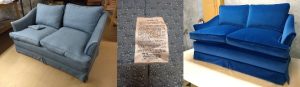
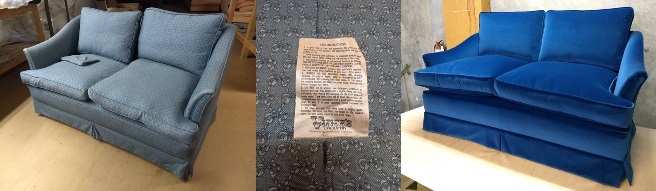
    We had previously reupholstered a Parker-Knoll 60’s wing back chair for a client who then requested us to reupholster two 2 ½ seater settees purchased in the early 80’s made by Vince’s Upholstery.

    Vince’s Upholstery was founded by Vince and Pina Scalisi who originally started the business from their home in East Perth making budget priced furniture. They progressed over time and became renowned for manufacturing top end custom-made lounge furniture from a purpose built factory in Morley.

    Our clients presented us with two identical looking 2 ½ seater settees however when we removed the fabric it became obvious they were purchased at different times as one settee featured a traditional sprung edge and the other a fabricated foam edge with different springs. The challenge was to reupholster the two settees so they both felt identical for comfort.

    We re-webbed the seats and fitted new coil springs of the same height and gauge then fabricated a foam edge on one settee to replicate the sprung edge of the other. We also replaced all existing hessian and body padding however the down and feather cushion inners were still in good condition so we encased these in 200g boned polyester fibre. The settees were reupholstered to the original finish in a cotton velvet then delivered to very happy clients!

    Call us Today
  • Cornwell Norton chairs – Reupholster

    Cornwell Furniture was formed in the 1960’s, a division of Parker Knoll Furniture in the United Kingdom. Cornwell was a signature range of Parker-Knoll specialising in high quality mass production motion chairs.

    The chair pictured is branded “Cornwell-Norton Ltd” which signifies it was manufactured in the Cornwell factory located at Chipping Norton in West Oxfordshire which commenced operations in the mid 60’s and closed in 2003.

    Our clients having migrated from the UK in the 1970’s had by now only a few remnant pieces of furniture from the homeland but their pride piece was this Cornwell Norton motion chair which they wanted rejuvenated..

    We completely removed all the upholstery from the frame which was well constructed from Beech and plywood. The mechanical action was a simple push mechanism however it remained in good working condition which is a tribute to the designers of the day. The frame required no attention and was re-webbed using heavy grade elastic webbing then padded utilising high density polyurethane foam. The cushion inserts were fabricated from premium foam and encased with bonded polyester fibre and the outside arms and outside back were lined then padded.

    The fabric selected by our clients was an English striped chenille which was period for the furniture and also suited the particular design. The chair was then upholstered to its original condition trimmed with piping and the cushions completed with buttoning.

    Our clients were elated with their chair rejuvenated to back to its stylish sixties finish and no doubt it bought back many wonderful memories of the era.

    Call us Today
  • Re-upholster Antique Chairs

    Occasionally we receive antique chairs which are basically well preserved but they have been previously shabbily re-upholstered or upholstered out of context with the era. This rarely does the furniture justice and usually results in complete restoration.

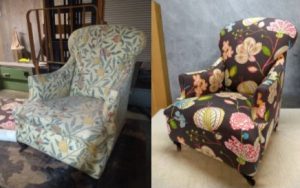
    Our client came to us with a lounge chair made in the 1890’s having been originally purchased by her deceased husband’s grandparents. She was honest in explaining that under her instructions the chair had been re-upholstered in the early 1980’s in a pastel cotton and the style modernised to match their décor at a previous residence. She was now ashamed of her previous decision and wanted the chair re-upholstered to its previous glory.

    The chair’s design had been modernised by having a loose seat cushion fitted and absence of piped detail. We removed all the upholstery stripping the chair down to the bare frame and the turned timber legs were then cleaned and polished. Heavy weight jute webbing was then fitted to the seat and back, the coil springs laced, tied down then hessian overlays fitted. We used synthetic ‘thumb roll’ on the seat front, arms and back scrolls then laminated premium polyurethane foams finished with polyester overlays. The seat cushion inner was fabricated from high resilience foam and encased with bonded polyester fibre.

    The chair was then upholstered using a fabric selected by our client which suited the chair and was basically in keeping with the period. The result was a chair which was modernised to a degree under the cover for comfort however retained much authenticity with the upholstery finish and piped detail. Our client was over joyed with her chair and no doubt will become a family heirloom.

    Call us Today
  • Re-upholster Charles Mackintosh chair

    A client approached us saying they had a ‘Mackintosh’ chair in desperate need of re-upholstery. They had purchased this lounge chair in the UK in the 1970’s and it had just been re-upholstered, they were told it was made about 1910 and was a Charles Rennie Mackintosh (1868 – 1928) design reflecting the ‘Arts and Craft’ period.

    Charles Rennie Mackintosh was a Scottish architect and designer who played an important role in the turn of the century ‘Arts and Craft’ movement. He became interested in architecture at a young age and enrolled into the Glasgow School of Art at fifteen meeting the McNair children (marring one of the sisters). The foursome collaborated becoming renowned for their refined stylization of furniture. In 1889 Mackintosh became an apprentice at the architectural firm Honeyman Kreppie and was made a partner in 1901. He demonstrated a break from traditional Victorian design being influenced by Japanese and Celtic art. He was famously commissioned by Catherine Cranston to design the Willow Tearooms (Glasgow) interiors and furniture for which he developed the famous Argyle chair.

    We completely stripped the upholstery to the frame on this chair and judging from the construction techniques it coincides with the period. The chair was then re-sprung and completely re-upholstered being covered in a linen supplied by our clients.

    There is however something extremely strange regarding this chair? The construction techniques coincide with the with the ‘Arts and Craft’ period and the design coincides with the Mackintosh style of the period however from our research he never designed a fully upholstered lounge chair, only dining and occasional chairs with a few show-wood framed lounge chairs. Our client loved their rejuvenated chair and the mystery remains!

    Call us Today
  • Club Lounge Restoration

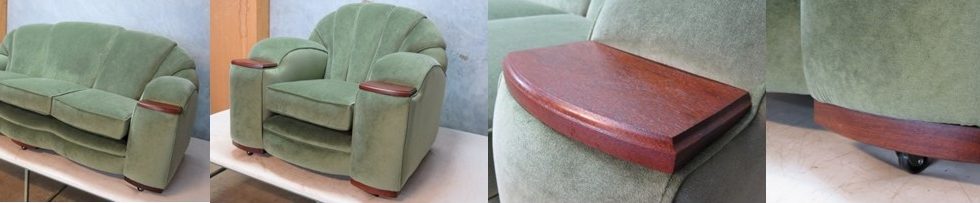
    Restoring an Australian Club Lounge is to a furniture manufacturer as what restoring a Holden or Falcon car is to a mechanic. Various versions of this Club Lounge style were produced in Australia from the late 1920’s through to the late 1950’s. There is a special place in our hearts for this type of lounge and we always welcome the challenge when being tasked with another Club Lounge restoration.

    A young lady from Geraldton approached us regarding restoring a club lounge originally belonging to her grandparents from a farm in Mullewa which had been stored in a sheering shed for several decades being home to the resident rodents. Her parents who had since run the family farm for many years transported the lounge suite to the factory then upon arrival we could see it was basically in good structural condition and still partially covered in the tattered original upholstery fabric.

    We removed all the upholstery stripping the lounge suite down to the bare frame. The frame joints we then partially knocked apart and re-glued with a crosslinking PVA and then screwed. The timber trays and base blocks sanded back with the cracks and dents being filled with two-pack resin. They were then finely sanded and given three coats of clear lacquer.

    The upholstery started with fitting heavy weight jute webbing, lacing in the coil springs then tying down the springs and fitting hessian overlays. We then fitted synthetic edge trim and laminated high density foam to the bodywork. The back flutes were fabricated from premium foam then encased with bonded polyester fibre back to the original shapes. The seat cushions were fabricated using the same method and the outside arms and backs were all lined and padded. The fabric covering was a ‘W’ pile velvet suitable for heavy use with the upholstery finish detailed back to original finish.

    Our client was elated upon receiving her re-upholstered furniture with a comment from her parents on our Instagram “who is a lucky girl” which said it all!

    Call us Today